Agentic AI for RevOps: What It Is and Why It’s Coming for Your Manual Processes

Agentic AI RevOps: What It Is and Why It’s Coming for Your Manual Processes
AI in RevOps used to mean better dashboards. Now it means AI agents that actually do the work — updating CRM records, routing leads, flagging deal risk, and executing workflows without waiting for a human to click “approve.” Here’s what that means for your team.
For the past few years, “AI in RevOps” mostly meant smarter analytics. Better forecasting models. Conversation intelligence that could tell you a rep said “um” too many times. Useful stuff, but fundamentally still a human-reads-insight, human-takes-action model.
That’s changing fast.
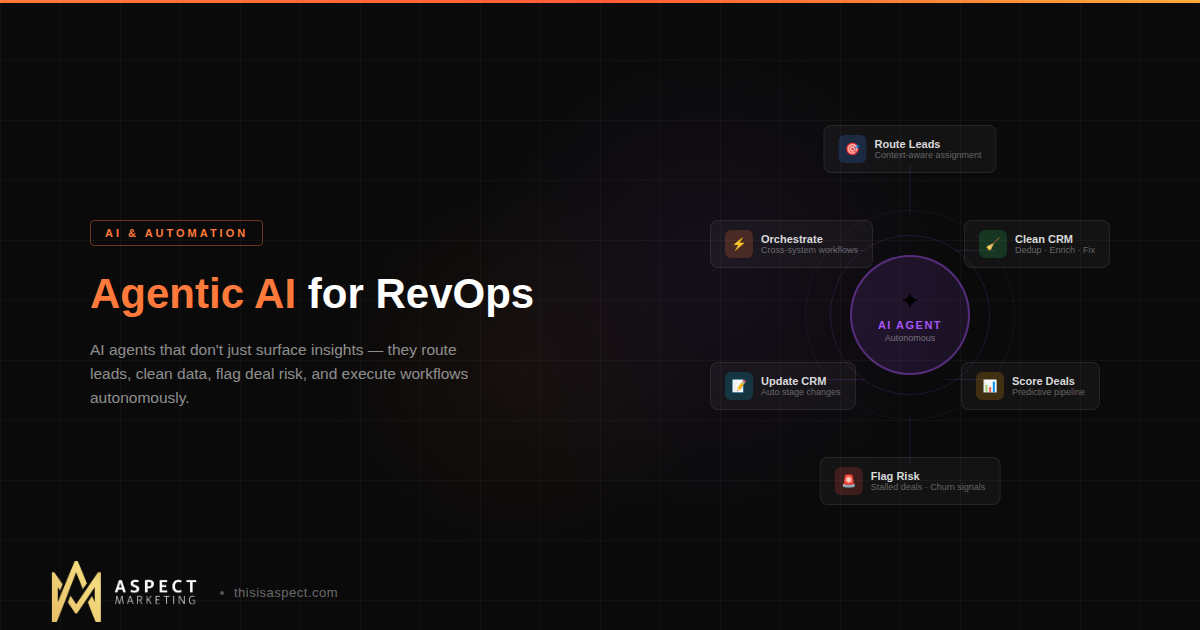
Agentic AI is a different category entirely. Instead of surfacing insights and waiting for someone to act on them, agentic AI systems evaluate data, make decisions, and execute multi-step workflows autonomously — within defined parameters, but without a human approving each step.
For RevOps teams, this is the most significant shift since the function itself was invented. And whether you’re ready or not, it’s already happening. Gartner projects that 40% of enterprise applications will include task-specific AI agents by end of 2026. According to Deloitte, 50% of enterprises using generative AI will have deployed autonomous agents by 2027. This isn’t a five-year roadmap. It’s an 18-month reality.
Let’s talk about what it actually looks like in practice.
What Makes Agentic AI Different from Regular Automation
Traditional automation is trigger-based. When X happens, do Y. A new contact fills out a form, HubSpot enrolls them in a workflow. A deal hits a certain stage, a task gets created. These are if-then rules that execute the same way every time regardless of context.
Agentic AI is different in three critical ways.
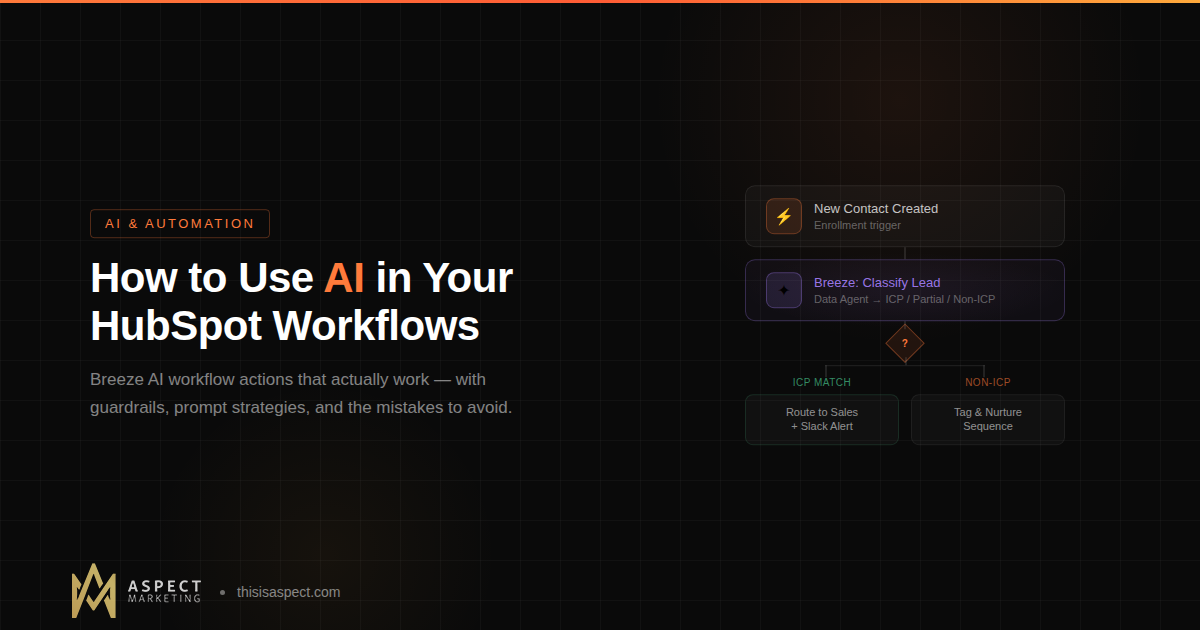
First, it evaluates context before acting. An AI agent doesn’t just see “new contact created” — it looks at the contact’s company size, industry, engagement history, website behavior, and firmographic data, then decides whether to route them to sales immediately, enroll them in a nurture sequence, or flag them as non-ICP. The decision changes based on the inputs, not a static rule.
Second, it chains multiple actions together. A single agent can update the CRM record, enrich the contact with third-party data, score the lead, notify the right rep via Slack, and draft a personalized follow-up email — all as one coordinated sequence rather than five separate automations that someone had to build and maintain individually.
Third, it adapts over time. As the agent processes more data, its decisions improve. The lead scoring gets more accurate. The routing gets smarter. The follow-up timing gets better. This is fundamentally different from a workflow that does the same thing on day one as it does on day one thousand.
Where Agentic AI Is Already Working in RevOps
The hype cycle for agentic AI is real, but so are the practical use cases. Here’s where teams are actually deploying agents today — not in lab settings, but in production.
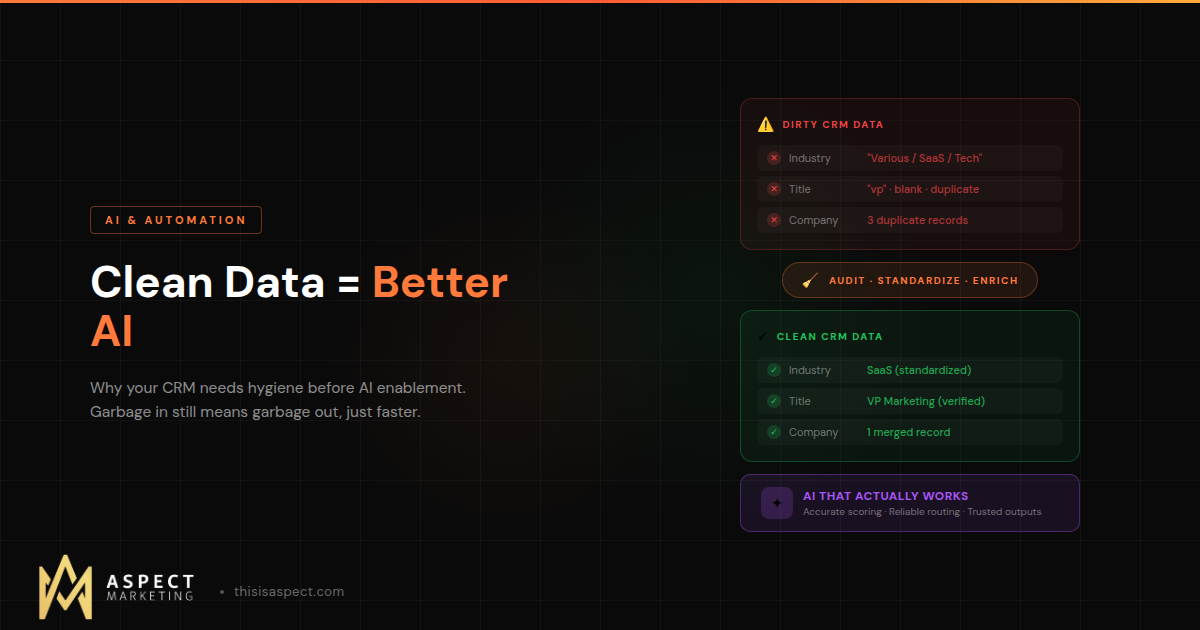
CRM hygiene and data maintenance. This might be the least exciting use case and the most impactful. AI agents that continuously scan your CRM for duplicates, incomplete records, outdated information, and inconsistent formatting — and fix them automatically. For RevOps teams that spend hours every week on manual data cleanup, this is transformative. And it directly improves every other AI use case, because clean data is the foundation that determines whether your AI investments deliver or disappoint.
Intelligent lead routing. Instead of round-robin assignment or basic territory rules, AI agents evaluate lead quality, rep capacity, historical win rates by segment, and real-time availability to route leads to the rep most likely to close them. Speed-to-lead improves because the routing happens instantly, and conversion rates improve because the matching is smarter.
Deal risk detection and coaching. Agents that monitor pipeline activity — email engagement dropping off, champion going quiet, competitor mentions in calls — and proactively flag at-risk deals before they stall. Some platforms are taking this further by generating specific coaching recommendations for the rep based on what’s happening in the deal.
Automated pipeline management. CRM records that update themselves based on actual activity rather than requiring reps to manually move deals between stages. If a proposal was sent, the agent updates the stage. If a meeting was completed, the agent logs the outcome. Sales reps currently spend only about 28% of their time actually selling — agentic AI is designed to flip that ratio by handling everything around the sell.
Cross-system workflow orchestration. This is where it gets particularly interesting for RevOps. Agents that operate across your tech stack — not just within a single tool — coordinating actions between your CRM, marketing automation, support platform, and communication tools. A deal closes in HubSpot, and the agent automatically triggers onboarding in your project management system, creates a customer success record, schedules a kickoff call, and notifies finance. One event, five systems, zero manual handoffs.
What This Means for the RevOps Role
Here’s the part that matters most for RevOps professionals: agentic AI doesn’t eliminate the RevOps function. It elevates it.
The role shifts from being the person who builds and maintains workflows to being the person who governs intelligent systems. You’re no longer writing if-then rules — you’re defining the parameters within which AI agents operate. What data can they access? What decisions are they authorized to make? What requires human review? How do you measure whether they’re performing correctly?
This is a fundamentally more strategic role. And it requires a different skill set. RevOps teams need to understand how AI models work (at least conceptually), how to audit AI outputs for accuracy, how to design governance frameworks, and how to communicate the value and limitations of AI to leadership.
The RevOps operating model is evolving from process architect to systems governor. The teams that make this transition successfully will be the ones that treat agentic AI as a capability to manage, not a magic button to press.
The Prerequisites Most Teams Are Skipping
Here’s where the hype runs into reality. Agentic AI has real prerequisites, and most teams don’t meet them yet.
Clean, structured data. AI agents are only as good as the data they operate on. When humans work with bad data, they often catch the errors. When AI works with bad data, it produces confidently wrong outputs at scale — bad forecasts, mis-routed leads, inaccurate attribution, flawed coaching recommendations. If your CRM has 40% duplicate contacts and inconsistent property values, deploying an AI agent on top of it doesn’t fix the problem. It amplifies it.
Well-defined processes. Agentic AI automates and enhances processes. If your lead handoff process is undefined, your deal stages are vague, and your reporting definitions vary by team, an AI agent has nothing coherent to work with. Get the processes right first — even if they’re manual — then layer in AI to scale them.
Integration architecture. AI agents that work across systems need those systems to be properly integrated. If your CRM and marketing platform don’t share data cleanly, an agent that tries to coordinate actions between them will create more chaos than value. Your tech stack integration layer needs to be solid before agents can orchestrate across it.
Governance framework. This is the one almost everyone skips. Before deploying any AI agent, you need to define what decisions it can make autonomously, what requires human approval, how you monitor its performance, what happens when it makes a mistake, and who’s accountable. Without governance, you’re not deploying an agent — you’re deploying a liability.
Where HubSpot Fits in the Agentic AI Landscape
If you’re running HubSpot, you’ve already seen the early stages of this shift. Breeze AI brought AI-powered workflow actions — lead classification, content generation, data enrichment — directly into HubSpot’s workflow engine. The “Run Agent” action lets you trigger AI agents inside standard workflows, which means your existing automation infrastructure can incorporate agentic capabilities without ripping anything out.
But HubSpot is also being honest about the current limitations. AI actions cost credits. Accuracy rates aren’t 100%. And the most complex agentic use cases — true cross-system orchestration with autonomous decision-making — still require tools beyond what any single platform offers natively.
The practical approach for most B2B teams in 2026: use HubSpot’s native AI capabilities for the high-value, well-defined use cases (lead classification, deal intelligence, content personalization), and evaluate specialized agentic platforms for the more complex orchestration scenarios as the market matures.
How to Start Without Over-Committing
If agentic AI feels overwhelming, here’s the practical starting path:
Start with one agent on one process. Pick a manual process that’s well-defined and high-volume — CRM data cleanup, lead routing, or meeting follow-up are good candidates. Deploy a single AI agent, measure its accuracy over 30 days, and iterate.
Treat AI accuracy like you treat data quality. Monitor it. Measure it. Report on it. If an AI agent is routing leads with 85% accuracy, that means 15% are going to the wrong rep. Is that acceptable? For how long? What’s the improvement trajectory? These are RevOps questions that need RevOps rigor.
Build the governance framework early. Define the rules before you scale. It’s much easier to establish AI governance with one agent than with fifteen.
Invest in data quality first. If you had to choose between deploying an AI agent today or spending the next quarter cleaning your CRM data, clean the data. Every agent you deploy later will perform better because of it.
The companies winning with agentic AI in RevOps aren’t the ones moving fastest. They’re the ones building on the right foundation — clean data, defined processes, integrated systems, and clear governance. The AI is the easy part. The operational discipline is what separates the teams that get value from the teams that get chaos.
If you’re thinking about where agentic AI fits in your revenue operation, let’s talk through your setup. The starting point isn’t buying a tool — it’s understanding whether your foundation is ready for one.
Kevin Kyser is the founder of Aspect Marketing, a HubSpot Partner agency specializing in RevOps, GTM strategy, and AI-powered automation for B2B teams.