
 HubSpot
 FirstTouch
 Instantly
 Aircall
 Gorgias
 Introw
 Google Ads
 Netlify
 ElevenLabs
 PandaDoc
What Is RevOps? A Practical Guide for B2B Teams
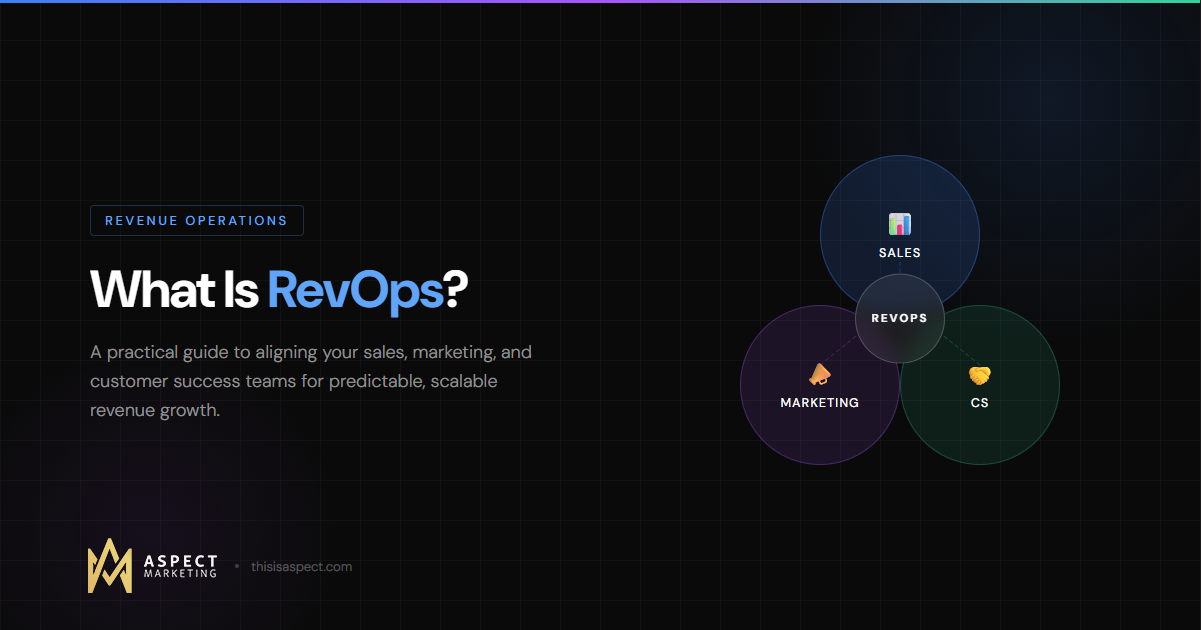
Revenue Operations (RevOps) aligns sales, marketing, and customer success teams. Discover what is revops, why it matters, and how to start.
If your sales team blames marketing for bad leads, and marketing says sales isn't following up fast enough, you don't have a people problem. You have an alignment problem. And that's exactly what Revenue Operations exists to solve.
RevOps has gone from buzzword to business-critical in a remarkably short time. Gartner projects that 75% of high-growth companies will have a dedicated RevOps function by 2026. And companies that have already made the investment are seeing real results, 19% faster growth and 15% higher profitability according to recent research.
But here's the thing: most content about RevOps makes it sound more complicated than it needs to be. At its core, RevOps is a straightforward concept. Let's break it down. In this guide, we will explore what is revops and how it can benefit your organization.
RevOps in Plain English
Revenue Operations is the practice of aligning your sales, marketing, and customer success teams under a shared operational framework, with unified data, connected tools, and consistent processes across the entire customer lifecycle.
Think of it this way. In most B2B companies, each revenue team operates with its own tools, its own metrics, and its own definition of what a "qualified lead" even means. Marketing is optimizing for MQLs. Sales is focused on quota. Customer success is tracking churn. Everyone is working hard, but they're pulling in slightly different directions.
RevOps puts someone (or a team) in charge of the connective tissue between those functions. It ensures that the data flowing from a first website visit all the way through to a renewal is clean, consistent, and visible to everyone who needs it.
The end result? Fewer dropped handoffs. Faster deal cycles. Better forecasting. And a customer experience that doesn't feel like it was designed by three separate companies.
Why RevOps Matters Now More Than Ever
A few things have changed that make RevOps essential in 2026, not optional.
Tech stacks have exploded. The average B2B company uses somewhere between 40 and 90 SaaS tools. Without someone overseeing how those systems connect and share data, you end up with a mess of duplicate records, broken automations, and dashboards nobody trusts.
AI requires clean data. Every company wants to use AI for lead scoring, forecasting, and personalization. But AI is only as good as the data it runs on. If your CRM is full of duplicates, missing fields, and outdated records, AI won't save you, it'll amplify the chaos. RevOps is the function that ensures your data is AI-ready.
Buyers have changed. Today's B2B buyers do the majority of their research before ever talking to sales. They interact with your marketing content, your website, your product reviews, and even AI-powered search tools. If your teams aren't aligned on how to track and respond to that journey, you're flying blind.
Growth is getting harder. In a tighter economic environment, companies can't afford to throw more headcount at revenue problems. They need to get more efficient with what they have. RevOps is how you do that, it's your efficiency engine.
The Four Pillars of RevOps
Every effective RevOps function is built on four pillars. Miss one, and the whole thing wobbles.
1. People
RevOps only works when the humans involved, across sales, marketing, and customer success, are aligned on shared goals and accountable to shared metrics. This doesn't mean everyone reports to the same person (though some orgs do structure it that way). It means there's a clear understanding of who owns what, where the handoffs happen, and how success is measured across the full funnel.
At minimum, you need someone who can see across all three functions and has the authority to make process and system decisions. That might be a dedicated RevOps hire, a fractional RevOps partner, or an agency that fills that role for you.
2. Process
This is where RevOps gets tactical. It's about mapping the entire customer lifecycle, from first touch to closed-won to renewal, and identifying every handoff, bottleneck, and friction point along the way.
Common processes RevOps owns include lead scoring and routing, opportunity stage definitions, SLA agreements between marketing and sales, onboarding workflows, and renewal/expansion playbooks. The goal is standardization without rigidity. You want repeatable processes that still let your teams adapt to real-world situations.
3. Technology
Your CRM is the foundation, but RevOps extends to every tool in your stack, marketing automation, sales engagement, support ticketing, analytics, and more. The RevOps function is responsible for ensuring these tools talk to each other, that data flows cleanly between them, and that the stack as a whole serves the business rather than creating more work.
This is where a platform like HubSpot becomes incredibly powerful. Because HubSpot's Marketing, Sales, Service, and Data Hubs all live on the same CRM, you eliminate a huge amount of the integration headaches that plague companies running five or six disconnected tools. It's not the only path, but it's one of the most efficient ones, especially for SMBs and mid-market companies that don't have a team of developers to maintain custom integrations.
4. Data
Data is the backbone of everything in RevOps. Clean, governed, trustworthy data powers your reporting, your automations, your AI, and your decision-making. Dirty data does the opposite, it erodes trust, breaks workflows, and makes your dashboards useless.
RevOps owns the data strategy: what gets tracked, how it's structured, who can modify it, and how it's maintained over time. This includes things like establishing a data dictionary, running regular deduplication, enforcing property standards in your CRM, and building dashboards that leadership actually trusts.
RevOps vs. Sales Ops vs. Marketing Ops
This is where people often get confused, so let's clarify.
Sales Ops focuses specifically on making the sales team more efficient, CRM management, pipeline reporting, territory planning, compensation. It's a well-established function, but it only covers one piece of the revenue puzzle.
Marketing Ops does the same for marketing, campaign execution, lead management, marketing automation, attribution. Again, valuable but limited in scope.
RevOps sits above both. It takes a holistic view of the entire revenue lifecycle, connecting the dots between marketing, sales, and customer success. It's not a replacement for Sales Ops or Marketing Ops, it's the orchestration layer that makes sure they're all working from the same playbook.
Think of it like this: Sales Ops optimizes one leg of the relay race. Marketing Ops optimizes another. RevOps makes sure the baton handoffs are clean and everyone is running toward the same finish line.
Signs Your Business Needs RevOps
Not sure if RevOps is relevant to you? Here are some common symptoms of a company that needs it.
Your sales and marketing teams disagree on what counts as a qualified lead. Your CRM data is messy and nobody trusts the reports. Leads fall through the cracks during handoffs between teams. You can't accurately attribute revenue back to specific marketing activities. Your tech stack has grown organically and nobody fully understands how it all connects. Forecasting feels more like guessing than predicting. Customer onboarding is inconsistent and varies by rep.
If you recognized more than two or three of those, you're not alone. Most B2B companies in the $2M-$50M range are dealing with some version of these problems. The good news is that they're all solvable, and RevOps is the framework for solving them.
How to Get Started with RevOps
You don't need to overhaul everything at once. Here's a practical starting point.
Start with an audit. Map your current customer lifecycle from first touch to renewal. Document every tool, every handoff, and every metric each team is tracking. You'll almost certainly find gaps, redundancies, and broken links.
Align on definitions. Get your sales and marketing leaders in a room and agree on shared definitions, what is an MQL? An SQL? When exactly does a lead become an opportunity? This alone can unlock massive improvements.
Clean your data. Before you build anything new, fix what's broken. Deduplicate your CRM, standardize your properties, and establish governance rules so it stays clean going forward.
Connect your tools. Make sure your core systems, CRM, marketing automation, support, and analytics, are integrated and sharing data. If you're on HubSpot, a lot of this is native. If not, tools like Zapier, n8n, or middleware solutions can bridge the gaps.
Build your dashboards. Create a shared view of the metrics that matter, pipeline velocity, conversion rates at each stage, attribution, and customer health. When everyone looks at the same numbers, alignment follows naturally.
Iterate. RevOps isn't a one-time project. It's an ongoing practice. Run regular reviews, identify what's working and what's not, and continuously optimize your processes, data, and tools.
The Bottom Line
RevOps isn't a department you build for the sake of building it. It's the operational backbone that connects your go-to-market teams, your data, and your technology into a revenue engine that actually runs.
Whether you build RevOps internally, hire a fractional lead, or partner with an agency that specializes in it, the important thing is to start. The companies that align their revenue operations now are the ones that will scale efficiently, forecast accurately, and outperform their competitors in the years ahead.
At Aspect Marketing, we help B2B teams build and optimize their revenue operations, from HubSpot implementation and CRM migration to AI automation and full-stack integration. If you're ready to get your RevOps foundation right, let's talk.