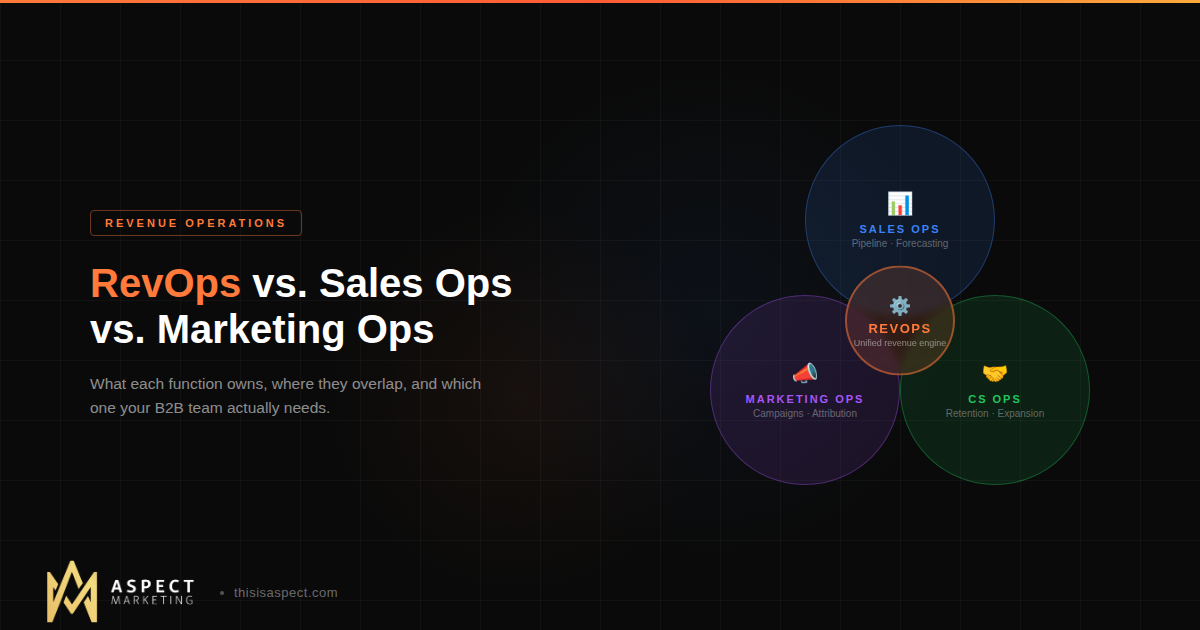
RevOps vs. Sales Ops vs. Marketing Ops: What’s the Difference and Why It Matters

These three functions sound similar, but they solve very different problems. Here’s how to think about each one — and which one your B2B team actually needs right now.
If you’ve spent any time in B2B operations, you’ve probably heard all three of these terms used interchangeably. Someone says “we need RevOps” when they really mean they need a better sales process. Someone else says “marketing ops will handle it” when the issue is actually a cross-team data problem that nobody owns. Understanding the nuances of revops vs sales ops is crucial for clarity.
The confusion is understandable. Revenue Operations, Sales Operations, and Marketing Operations all exist to make revenue teams more effective. They all involve data, tools, and processes. And in smaller companies, one person often wears all three hats.
But they’re not the same thing. And if you don’t understand where each one starts and stops, you’ll end up with overlapping efforts, competing dashboards, and the kind of misalignment that quietly kills pipeline without anyone noticing.
Let’s break it down.
In the context of B2B operations, it is essential to differentiate between revops vs sales ops to optimize your team’s effectiveness and strategy.
Understanding RevOps vs Sales Ops
Sales Operations: Making the Sales Team Sell Better
Sales Ops is the most established of the three. It’s been around for decades, and its job is straightforward: remove friction from the sales process so reps can spend more time selling and less time on everything else.
In practice, Sales Ops owns things like CRM administration and pipeline architecture, territory design and quota planning, sales forecasting and pipeline reporting, lead routing rules and deal stage definitions, sales tool evaluation and adoption, and compensation plan modeling.
The scope is intentionally narrow. Sales Ops exists to serve the sales team. When a rep says “I don’t know which leads to call” or “our pipeline report doesn’t match reality,” that’s a Sales Ops problem. When the VP of Sales needs a forecast for the board, Sales Ops builds it.
The metrics Sales Ops cares about are sales-specific: win rate, average deal size, sales cycle length, pipeline velocity, quota attainment. These are important numbers, but they only tell you how the sales team is performing — not how the full revenue engine is working.
Sales Ops works best when your sales team has enough complexity to justify dedicated operational support — typically once you have 5+ reps, a defined pipeline, and enough deal volume that manual processes start breaking down.
Marketing Operations: Making Campaigns Run and Prove Their Value
Marketing Ops emerged as marketing became more technical and data-driven. It’s the function that ensures campaigns actually execute properly, data flows into the right places, and marketing can prove what’s working.
Marketing Ops typically owns the marketing automation platform (HubSpot Marketing Hub, Marketo, etc.), campaign execution infrastructure and email deliverability, lead capture forms, landing pages, and tracking, marketing attribution and performance reporting, audience segmentation and list management, and marketing data hygiene and compliance.
Where Sales Ops makes reps more productive, Marketing Ops makes campaigns more reliable. It’s the team that ensures your nurture sequences actually fire, your lead scoring model reflects reality, and your attribution reporting doesn’t fall apart every time someone changes a UTM parameter.
The metrics here are marketing-specific: MQLs generated, cost per lead, email engagement rates, campaign ROI, channel attribution. Like Sales Ops, Marketing Ops does important work — but its view ends at the handoff point. Once a lead becomes a sales opportunity, it’s often out of Marketing Ops’ line of sight.
Marketing Ops works best when your marketing function has grown beyond “one person doing everything” and you need someone to own the systems and data behind campaign execution — typically once you’re running multi-channel campaigns, managing a database of 10,000+ contacts, or trying to prove marketing’s contribution to pipeline.
Revenue Operations: The Cross-Functional Operating Model
RevOps is the newest of the three, and it’s fundamentally different. It’s not a department-specific support function — it’s an operating model that aligns sales, marketing, and customer success around shared data, shared processes, and shared accountability for revenue.
RevOps owns the end-to-end customer lifecycle architecture, unified reporting across all revenue teams, cross-functional process design (lead-to-revenue, handoff protocols), the full GTM tech stack and integration layer, company-wide lifecycle stage definitions, revenue forecasting that accounts for the full funnel, and data governance standards that apply across every team.
The reason RevOps exists is simple: customers don’t experience your company in departmental silos. A prospect moves from a marketing touchpoint to a sales conversation to a customer success onboarding — and if those three teams are operating with different data, different definitions, and different tools, the experience is disjointed and revenue leaks through the cracks.
RevOps solves this by creating one operational layer that spans the entire revenue cycle. Instead of each team optimizing its own tools and processes in isolation, RevOps ensures that a “qualified lead” means the same thing to marketing as it does to sales. That pipeline data is consistent whether you’re looking at it in the CRM, the marketing platform, or the customer success tool. That when someone asks “what drove revenue last quarter,” there’s one answer — not three competing ones.
RevOps works best when your business has matured to the point where misalignment between teams is costing you revenue — deals falling through handoff cracks, conflicting reports, duplicated tech spend, or a customer journey that feels fragmented.
The Real Differences: A Practical Comparison
Here’s where it gets concrete.
Scope. Sales Ops serves the sales team. Marketing Ops serves the marketing team. RevOps serves the entire revenue organization — and sometimes reports directly to the CEO or CRO rather than any single department head.
Data ownership. Sales Ops creates a single source of truth for sales data. Marketing Ops does the same for marketing data. RevOps creates a single source of truth for all revenue data — which is why it typically owns the CRM, the integration architecture, and the data governance standards that every team follows.
Tech stack role. Sales Ops evaluates tools that help reps sell. Marketing Ops evaluates tools that help marketers execute campaigns. RevOps owns the full GTM tech stack and ensures every tool integrates properly, data flows bidirectionally, and the stack doesn’t become a collection of disconnected silos.
Metrics. Sales Ops tracks win rates, pipeline velocity, and quota attainment. Marketing Ops tracks MQLs, campaign ROI, and attribution. RevOps tracks cross-functional metrics like customer acquisition cost relative to lifetime value, full-funnel conversion rates, revenue retention, and the efficiency of the entire customer lifecycle.
Process design. Sales Ops optimizes the sales process. Marketing Ops optimizes campaign workflows. RevOps designs the connective tissue between them — how marketing-qualified leads become sales opportunities, how closed deals transition to customer success, and how customer feedback flows back to product and marketing.
Which One Do You Need?
This is the question everyone really wants answered. And the honest answer depends on where you are.
If your sales team is your primary bottleneck — reps don’t have clear processes, forecasting is unreliable, your CRM is a mess — start with Sales Ops. Get the fundamentals right before trying to align across teams.
If your marketing engine needs operational maturity — campaigns are inconsistent, you can’t prove what’s driving pipeline, your marketing data is unreliable — start with Marketing Ops. You need someone owning the systems before you can integrate them into a broader model.
If the gaps are between teams, not within them — marketing says they sent great leads but sales disagrees, handoffs are where deals go to die, every team has a different number for the same metric — you need RevOps. The problem isn’t that individual teams aren’t working hard. It’s that they’re not working together, and nobody owns the space between them.
The good news: these aren’t mutually exclusive. In fact, the best RevOps operating models don’t eliminate Sales Ops and Marketing Ops — they provide the overarching framework that keeps those functions aligned. Marketing Ops still runs campaigns. Sales Ops still manages pipeline. But RevOps ensures they’re working from the same data, the same definitions, and toward the same revenue goals.
The Most Common Mistake: Renaming Without Restructuring
Here’s something we see all the time: a company takes their existing Sales Ops person, changes their title to “RevOps,” and expects cross-functional alignment to magically happen.
It doesn’t.
RevOps isn’t a title change. It’s a structural change. It means someone (or a team) has the authority and mandate to standardize processes across marketing, sales, and customer success. It means one team owns the tech stack integration layer rather than each department buying their own tools. It means lifecycle stages, lead definitions, and reporting logic are governed centrally rather than defined differently by every team.
If you rename the role without changing the authority structure, you just have a Sales Ops person with a fancier title and more meetings.
Where to Start If You’re Building From Scratch
If you’re a growth-stage B2B company that hasn’t formalized any of these functions yet, here’s the practical path:
Step 1: Get your CRM right. Before you can do any kind of operations work — sales, marketing, or revenue — you need a clean, properly configured CRM as your foundation. If you’re on HubSpot, start with the fundamentals. Lifecycle stages, pipeline architecture, property standards, data hygiene — this is the foundation everything else builds on.
Step 2: Assign operational ownership based on your biggest pain point. If sales process is the bottleneck, hire or designate a Sales Ops function first. If marketing execution is the gap, start with Marketing Ops. Don’t try to do everything at once.
Step 3: Move toward RevOps as you scale. As your team grows and the handoff points between marketing, sales, and customer success become friction points, layer in RevOps as the unifying framework. This doesn’t mean replacing what you built — it means connecting it.
Step 4: Centralize the tech stack and data governance. This is where RevOps really earns its keep. One person or team owns how tools integrate, how data flows, and what the shared definitions are. No more competing dashboards. No more “which number is right?” conversations.
The Bottom Line
Sales Ops, Marketing Ops, and RevOps aren’t competing approaches. They’re different scopes of the same problem: making your revenue engine work better.
Sales Ops makes your sales team more effective. Marketing Ops makes your marketing machine more reliable. And RevOps makes sure both of those functions — plus customer success — are actually rowing in the same direction.
The companies that grow predictably aren’t the ones that pick one and ignore the others. They’re the ones that start where the pain is, build operational maturity in each function, and eventually connect them under a RevOps model that treats revenue as a full-lifecycle outcome rather than a departmental metric.
If you’re feeling the friction between teams and not sure where to start, let’s talk. We help B2B companies design the operational model that fits where they are right now — and builds toward where they need to be.
Kevin Kyser is the founder of Aspect Marketing, a HubSpot Partner agency specializing in RevOps, GTM strategy, and AI-powered automation for B2B teams.