
Clean Data = Better AI: Why Your CRM Needs Hygiene Before AI Enablement
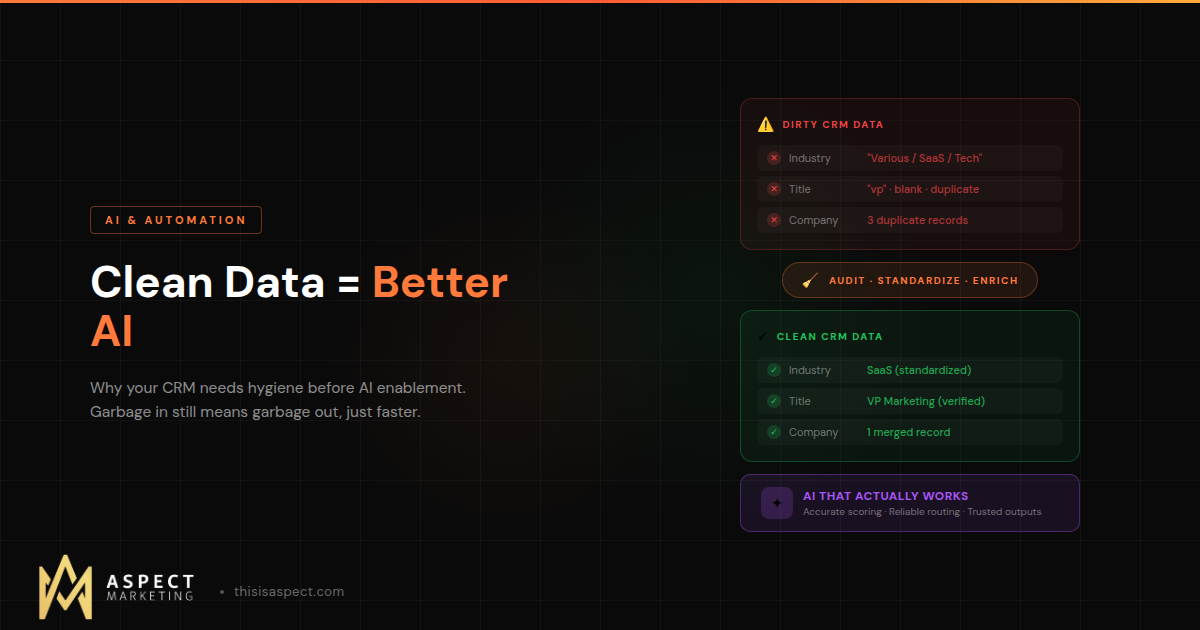
Every AI initiative in RevOps depends on the same foundation: clean, structured, trustworthy CRM data. Skip the hygiene work, and your AI investments will deliver confidently wrong outputs at scale. Here’s why data quality is the prerequisite, and how to fix it before you fix anything else.
There’s a quiet pattern playing out in B2B companies right now. Leadership reads about agentic AI, generative workflows, and predictive scoring. They allocate budget. They buy tools. They roll out HubSpot’s Breeze AI, or a new enrichment platform, or a predictive forecasting layer.
And three months later, it’s not working the way the demo promised.
The leads are getting scored, but the scores don’t predict conversion. The AI agents are running, but they’re making decisions on incomplete records. The personalized email outputs are technically personalized, except half of them reference the wrong company size or industry. Everyone’s frustrated. Some teams blame the AI. Smart teams recognize what’s really happening: the AI isn’t broken. The data underneath it is.
According to Precisely, 67% of organizations don’t completely trust the data they use for decisions. And 62% cite a lack of data governance as a primary challenge inhibiting their AI initiatives. McKinsey reports that 67% of companies can’t scale AI at all. None of these are AI problems. They’re data problems wearing AI costumes.
If you’re planning AI deployments in 2026, the most valuable thing you can do isn’t pick the right tool. It’s get your data right first.
Why AI Amplifies Bad Data Instead of Tolerating It
Here’s the thing that catches teams off guard. Humans working with bad data tend to catch errors. A rep gets a lead routed to them, sees the company name is misspelled and the industry says “Various,” and figures something’s off. They check, they research, they fix it.
AI doesn’t do that. AI takes the data at face value, makes a decision, and executes. At speed. At scale. Confidently.
When an AI agent routes a lead based on a “Manufacturing” tag that’s actually wrong, it routes it confidently. When a generative email writer drafts outreach referencing the company’s product line based on enrichment data that’s stale by 18 months, the email goes out confidently. When predictive scoring assigns a high score because the contact has “VP” in their title field (but they’re actually a junior coordinator whose title was never updated), the lead lands in sales’ high-priority queue confidently.
The problem compounds. Every downstream system that consumes that AI output now has wrong information baked in. Reports get distorted. Forecasts get wrong inputs. Coaching decisions get made on bad foundations.
This is why “clean data is the prerequisite to AI enablement” isn’t a nice-to-have framing. It’s the difference between AI that delivers value and AI that produces well-formatted nonsense.
What “Clean Data” Actually Means in a CRM Context
Before you can fix it, you need to know what you’re fixing. Clean CRM data has six characteristics:
Accuracy. The information matches reality. The phone number actually reaches the contact. The job title reflects what they actually do. The company size is current, not from when the record was created three years ago.
Completeness. The fields you need for decisions are populated. If your routing logic depends on industry, country, and company size, those three properties need to be filled in across your database, not just on the most recent 20% of records.
Consistency. The same concept is represented the same way everywhere. Industry isn’t “SaaS” on one record, “Software” on another, and “Technology” on a third. Country isn’t “US” here and “United States” there. Titles aren’t free-text chaos with twelve different spellings of “Vice President.”
Uniqueness. Each contact, company, and deal exists once. Not three duplicate contacts with slightly different email addresses that fragment activity history and confuse reporting.
Freshness. The data is current. Job changes get captured. Company growth gets reflected. Stale records get flagged or archived rather than continuing to inform decisions.
Structure. Data lives in the right fields with the right formats. Phone numbers follow a standard format. Email domains are isolated for analysis. Custom properties have clear definitions and naming conventions.
When all six are in place, AI works. When any of them are broken, AI breaks with them.
The Hidden Cost of Skipping This Step
Most teams underestimate what bad data is already costing them, before they ever add AI to the equation.
Sales reps spend hours every week manually verifying information that should be reliable. Marketing builds segments that exclude valid contacts because their records are incomplete. Forecasts come in inaccurate because deal stages weren’t updated or amounts were entered inconsistently. Reporting dashboards from different teams show different numbers for the same metric because nobody can agree on what “qualified” or “opportunity” or “engaged” means in practice.
Then AI gets added on top. And every one of these existing problems gets multiplied.
A 2026 study found that automated workflows and revenue intelligence tools depend on accurate, current, and structured CRM data to produce reliable outputs. When that foundation isn’t there, the tools don’t fail loudly. They fail quietly, with bad outputs that look reasonable until you actually trace them back to source. By that point, you’ve made decisions on flawed data, communicated those decisions to leadership, and started planning the next quarter against a forecast that was wrong from the beginning.
This is the silent cost. Not “AI didn’t work.” More like “AI made everything 40% more efficient at being wrong.”
The Practical Data Hygiene Framework
The good news: cleaning your CRM data isn’t a mystery. It just requires structure and discipline. Here’s the framework we apply with B2B clients.
Phase 1: Audit what you have. Start by understanding the current state. Run completeness reports on critical fields (industry, job title, company size, country, lifecycle stage). Identify duplicates and near-duplicates. Look at how consistent your enumerated fields are (industry, lead source, lifecycle stage). Pull a sample of records and check accuracy against external sources. You can’t fix what you haven’t measured, and most teams are shocked at the gap between what they think their data looks like and what it actually looks like.
Phase 2: Define your standards. Before cleaning anything, define what clean looks like. What are the allowed values for industry? What’s the canonical format for phone numbers? How do you spell out country names? What lifecycle stages exist, and what are the exact criteria for moving between them? Document these as a data dictionary. This becomes your reference point for every cleanup decision and every future record going forward.
Phase 3: Clean what’s there. With standards defined, work through your database systematically. Merge duplicates (use HubSpot’s duplicate management tools, or third-party platforms for larger jobs). Standardize enumerated fields. Fill in critical missing properties using enrichment tools (more on this in a second). Archive stale records that haven’t been touched in 12+ months. Fix obvious errors like personal email addresses logged as business contacts or “test test” records that never got removed.
Phase 4: Enrich what’s missing. For the fields you need that aren’t there, enrichment tools can fill gaps automatically. Cognism, ZoomInfo, Clearbit, and others integrate with HubSpot to append firmographic data, verify contact details, and refresh stale records. Pick the tool that matches your geography, budget, and accuracy needs. Just remember that enrichment data is only as good as the source, so audit accuracy before committing to a platform.
Phase 5: Build guardrails to keep it clean. This is the part that determines whether your cleanup lasts. Set up validation rules on critical fields. Use HubSpot workflows to flag records that don’t meet quality standards. Require key fields on form submissions. Train your team on data entry standards. And run monthly hygiene audits to catch new issues before they accumulate. Data quality isn’t a one-time project. It’s an ongoing practice.
Phase 6: Connect data quality to AI deployment. Now you’re ready. With clean, structured, enriched data, your AI initiatives have a foundation to work from. Lead scoring becomes accurate. Routing decisions become reliable. Generative outputs reference correct information. And the AI investments your leadership team approved actually deliver the ROI the vendors promised.
Where HubSpot Owners Should Start
If you’re running HubSpot specifically, you have built-in tools for most of this work.
Use the duplicate management tools. HubSpot’s native dedup features can identify potential duplicates in contacts and companies. For larger cleanups, third-party tools like Insycle or DemandTools work natively with HubSpot.
Set up data quality alerts. HubSpot’s Operations Hub (specifically Professional and Enterprise tiers) includes data quality tooling that flags inconsistencies, missing fields, and formatting issues automatically. If you have access to it, use it.
Standardize through automation. Build workflows that automatically format incoming data. Phone numbers get standardized on entry. Country names get mapped to a standard format. Lead source values get normalized. This prevents new inconsistencies from being introduced.
Audit your custom properties. Most HubSpot instances accumulate dozens of unused or redundant custom properties over time. Archive what you’re not using. Consolidate fields that overlap. A leaner property set is easier to keep clean.
For teams still building their HubSpot foundation, the onboarding checklist covers data architecture from the start. It’s much easier to set up clean data practices on day one than to retrofit them across a database that’s been growing organically for two years.
The Connection to Everything Else
Clean CRM data isn’t just an AI prerequisite. It’s the foundation that supports your entire revenue operation.
Lead scoring needs clean data. Without it, your scoring model is making decisions on incomplete or inconsistent inputs.
Tech stack integration needs clean data. If you’re building a connected GTM stack, the integration layer only works if the data flowing through it is reliable.
CRM migrations need clean data. If you’re moving from Salesforce to HubSpot, the worst thing you can do is migrate dirty data into your new instance.
Reporting needs clean data. So does forecasting. So does attribution. So does coaching. Every operational capability your revenue team relies on traces back to data quality.
And as agentic AI makes its way deeper into RevOps workflows, the teams winning will be the ones that did the unglamorous work of fixing their data first.
Start With One Object Type
If this all feels overwhelming, here’s how to get started without trying to fix everything at once.
Pick one object type. Contacts is usually the right starting point because it has the highest volume and the most downstream impact. Focus on the five or six properties that matter most for your business decisions. Spend a focused two-week sprint auditing, standardizing, deduplicating, and enriching that object. Build the guardrails to keep it clean.
Then move to companies. Then deals. Then activities. Within 60-90 days you’ll have a CRM you actually trust, and an AI deployment plan that has a real shot at working.
If your team doesn’t have the bandwidth to tackle this internally, or if you’re not sure where the worst data quality issues are hiding, we can help. Data hygiene work is unglamorous, but it’s some of the highest-leverage operational work a B2B company can do. It’s also the work that determines whether the next AI tool you buy actually moves the needle.
Kevin Kyser is the founder of Aspect Marketing, a HubSpot Partner agency specializing in RevOps, GTM strategy, and AI-powered automation for B2B teams.