Marketing Attribution Models Explained: How to Know What’s Actually Driving Revenue

Marketing Attribution Models Explained: How to Know What’s Actually Driving Revenue
Every time you decide where to spend your marketing budget, you’re making an attribution decision. The question isn’t whether to attribute revenue to channels. It’s whether you’re doing it accurately. Here’s a practical guide to attribution models for B2B teams.
Here’s an uncomfortable statistic to start with: only 21% of B2B marketers say they’re confident in their marketing attribution. That means nearly 80% of teams are making budget and channel decisions based on data they don’t fully trust.
And it gets worse when you consider the complexity of modern B2B buying. The average B2B buyer journey now involves dozens of touchpoints across multiple channels and a buying committee of around ten stakeholders. Research in 2026 shows that 61% of the decision path happens before a buyer ever talks to a sales rep. If you’re crediting all of that to a single first or last interaction, the rest of the journey is invisible to you.
Attribution is how you make that journey visible. It’s the framework that tells you which marketing efforts actually contribute to revenue, so you can invest more in what works and stop wasting money on what doesn’t. Let’s break down how it works, what the different models reveal, and how to pick the right approach for your business.
What Attribution Actually Means
Marketing attribution is the practice of assigning credit for a conversion (a closed deal, a qualified lead, a signup) to the marketing touchpoints that influenced it.
The challenge is that in B2B, conversions almost never come from a single touch. A prospect might discover you through a LinkedIn post, come back via an organic search a week later, download a guide, attend a webinar a month after that, click through three nurture emails, and finally request a demo. Which of those touchpoints gets the credit for the deal that eventually closes?
The answer depends entirely on which attribution model you use. And different models will give you genuinely different answers, which is exactly why understanding them matters.
The Single-Touch Models (Simple but Incomplete)
First-touch attribution gives 100% of the credit to the very first interaction a prospect had with your brand. If someone clicked a LinkedIn ad, then over six months downloaded three whitepapers, attended two webinars, and finally requested a demo, first-touch gives all the credit to that initial LinkedIn ad.
First-touch answers one question well: “What’s good at generating awareness and creating new contacts?” It tends to over-credit top-of-funnel discovery channels and tells you nothing about what actually closes deals. It’s useful if your primary concern is demand generation and filling the top of the funnel.
Last-touch attribution does the opposite. It assigns 100% of the credit to the final interaction before conversion. This is the most widely used model by default, mostly because it’s the standard built into most CRMs.
Last-touch answers “What’s good at closing?” and over-credits bottom-of-funnel actions like demo requests or pricing page visits. The problem is obvious: it completely ignores everything that built awareness and trust before that final click. The webinar that convinced the buyer, the content that educated them, the email that re-engaged them all get zero credit.
Both single-touch models are simple to implement and easy to understand. They’re also incomplete for any B2B sale with a cycle longer than 30 days and multiple stakeholders, which describes most B2B sales.
The Multi-Touch Models (More Realistic, More Complex)
Multi-touch attribution distributes credit across multiple touchpoints in the buyer journey. As of 2026, multi-touch adoption has grown to roughly 47% of B2B teams, as organizations recognize that single-touch models leave too much of the journey unaccounted for. Here are the main models:
Linear attribution splits credit equally across every touchpoint. If there were eight touches before conversion, each gets 12.5% of the credit. This is the simplest multi-touch model and it’s useful for understanding which channels appear most often in your buyer journeys. The limitation is that it treats a casual blog visit the same as a high-intent demo request, which isn’t realistic.
Time-decay attribution gives more credit to touchpoints closer to the conversion. The webinar a buyer attended the week before they signed gets more credit than the blog post they read six months earlier. This model is good for understanding what drives deals over the finish line, though it systematically under-credits the awareness-building activities that started the journey.
Position-based (U-shaped) attribution gives 40% credit to the first touch, 40% to the last touch, and distributes the remaining 20% across the middle touchpoints. This recognizes that the first interaction (which got the prospect in the door) and the last interaction (which drove conversion) are both especially important. It’s a solid middle-ground model for B2B teams that care about both demand generation and closing.
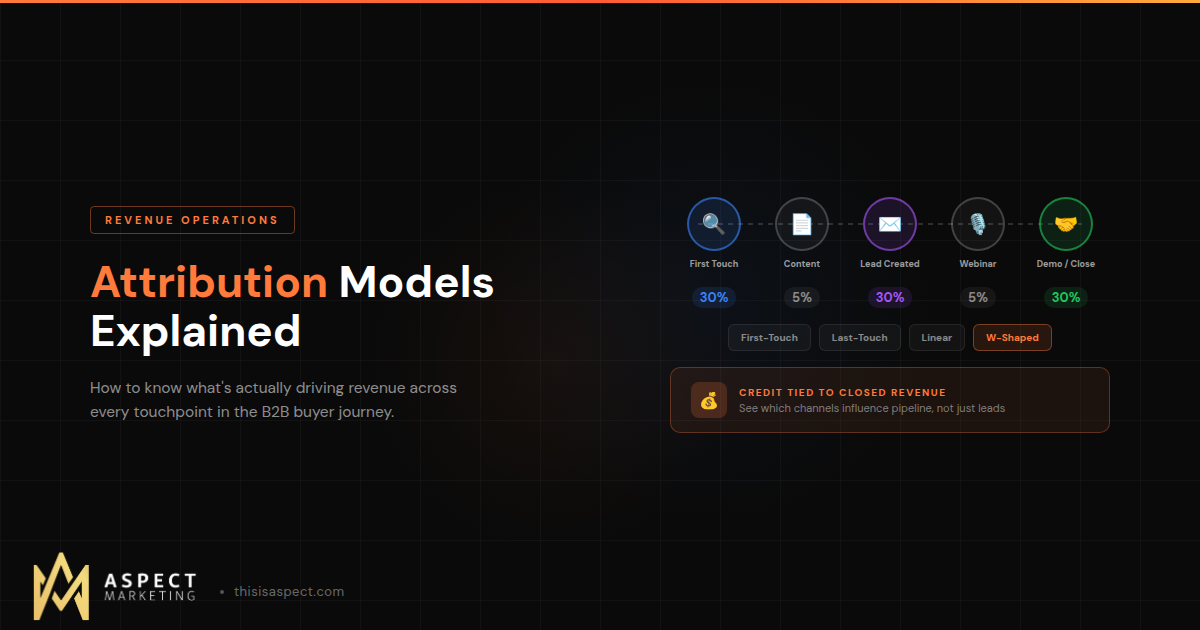
W-shaped attribution adds a third milestone. It splits credit between first touch (30%), lead creation (30%), and opportunity creation (30%), with the remaining 10% distributed across other touchpoints. This is particularly valuable for B2B teams because it recognizes the critical moment when a prospect becomes a qualified lead, and the moment they become a sales opportunity. If your funnel has well-defined lead and opportunity stages, W-shaped maps to how your business actually works.
Z-shaped (or full-path) attribution goes one step further, adding a fourth milestone for the closed deal. It gives roughly 22.5% each to first touch, lead creation, opportunity creation, and conversion, with 10% spread across the rest. This is best for complex B2B sales with long cycles and multiple defined stages.
Data-driven (algorithmic) attribution uses machine learning to assign credit based on patterns in your actual conversion data, rather than fixed percentages. Instead of you deciding that first touch deserves 30%, the algorithm analyzes which touchpoints actually correlate with conversion and weights them accordingly. This is the most accurate approach when you have enough data to support it, but it requires significant volume and clean data to work reliably.
The Custom Model Option
Most sophisticated platforms, including HubSpot, let you build custom attribution models where you define your own weighting based on what matters to your business. You might create a model that heavily weights demo requests and free trial signups because, in your specific sales cycle, those actions strongly predict conversion.
This is where attribution gets genuinely useful. The “right” weighting isn’t universal. It depends on your funnel, your sales motion, and what your data tells you about which actions actually precede revenue. A custom model lets you encode your team’s hard-won knowledge about your buyer journey into your reporting.
The Key Insight: Different Models Reveal Different Truths
Here’s the thing most attribution guides bury: you don’t necessarily need to pick one model and use it for everything. Different models answer different questions.
Linear attribution might show you that content marketing touches nearly every customer journey, even if it rarely gets the first or last touch. Time-decay might reveal which channels are best at closing. First-touch tells you what fills your funnel. Last-touch tells you what converts.
The smartest B2B teams look at multiple models side by side. If a channel looks weak under last-touch but strong under first-touch, that’s not a contradiction. It’s telling you that channel is an awareness driver, not a closer. You’d be making a mistake to cut its budget based on last-touch data alone.
This is why the model question is less “which one is correct” and more “which one answers the question I’m asking right now.”
The Prerequisite Nobody Talks About: Clean Data and Identity Resolution
Here’s where most attribution projects quietly fail. Teams pick a sophisticated model, implement it, look at the numbers, realize the data looks wrong, and abandon attribution altogether.
The problem usually isn’t the model. It’s the foundation underneath it.
Before any attribution model works, you need identity resolution: the ability to recognize that the anonymous website visitor who downloaded your ebook is the same person who clicked your LinkedIn ad last week and just filled out a demo form today. Without it, your multi-touch model counts the same person’s phone visit and desktop visit as two separate journeys, and your data becomes meaningless.
You also need clean, consistent CRM data. If your lead sources are inconsistent, your channels aren’t tagged properly, and your UTM parameters are a mess, your attribution reporting will be built on sand. This is the same reason clean data is the prerequisite to AI enablement: garbage in, garbage out, regardless of how sophisticated the model on top is.
This connects directly to the broader RevOps discipline. Attribution isn’t just a marketing reporting exercise. It requires the cross-functional data governance, consistent definitions, and integrated systems that RevOps exists to provide. If marketing, sales, and customer success are all tracking touchpoints differently, no attribution model will reconcile them.
How HubSpot Handles Attribution
If you’re running HubSpot, you have multi-touch revenue attribution built into the platform (on Professional and Enterprise tiers). HubSpot can track touchpoints across your marketing channels and apply different attribution models to the same data, so you can compare how channels perform under first-touch, last-touch, linear, U-shaped, W-shaped, and full-path models.
The advantage of attribution living inside HubSpot is that it connects directly to your CRM. Touchpoints tie to actual contacts, contacts tie to deals, and deals tie to revenue. This means you’re attributing real closed-won revenue, not just top-of-funnel conversions. For B2B teams, this is the difference between “this channel generated 200 leads” and “this channel influenced $400K in closed revenue.”
To make HubSpot attribution work well, your tech stack needs to feed clean data into the CRM. Your ad platforms, your website tracking, your forms, and your sales activities all need to be properly connected and consistently tagged. The attribution model is only the final layer. The data plumbing underneath it is what determines whether the numbers are trustworthy.
A Practical Approach for B2B Teams
If you’re getting started or rethinking your attribution, here’s a pragmatic path:
Start with the data foundation. Before you obsess over models, make sure your touchpoint tracking is clean. Standardize your UTM parameters. Make sure your forms and channels are properly tagged. Confirm your CRM is capturing the touchpoints you care about. This unglamorous work determines everything downstream.
Begin with position-based or W-shaped. For most B2B teams with defined funnel stages, these models offer the best balance of realism and interpretability. They credit both the channels that create awareness and the ones that drive conversion, without requiring the data volume that data-driven models need.
Compare models rather than committing to one. Look at your channels through multiple lenses. Use first-touch to evaluate demand gen, last-touch to evaluate closing channels, and a multi-touch model for your overall budget allocation. The contrast between models is itself a source of insight.
Connect attribution to revenue, not just leads. The whole point is to know what drives revenue. Make sure your attribution ties touchpoints to closed-won deals, not just MQLs. A channel that generates lots of leads that never close is not a channel worth more budget.
Revisit quarterly. Your channel mix changes, your buyer behavior shifts, and your model should be re-examined regularly. Attribution is a living practice, not a one-time setup.
The Bottom Line
Attribution isn’t about finding the one true model that perfectly captures reality. No model does that. It’s about replacing gut-feel budget decisions with evidence about which marketing actually influences revenue.
Teams that implement structured attribution frameworks report meaningful improvements in marketing ROI, not from spending more, but from spending smarter. When you can see which channels genuinely move deals forward, budget conversations shift from opinion and politics to evidence. Content teams can fund the assets tied to pipeline movement. And marketing’s contribution to revenue becomes visible instead of assumed.
You’re already making attribution decisions every time you allocate budget. The only question is whether you’re making them with good data or bad.
If your attribution reporting isn’t giving you answers you trust, or you’re not sure your data foundation can support it, let’s talk. We help B2B teams build attribution inside HubSpot that actually connects marketing activity to closed revenue.
Kevin Kyser is the founder of Aspect Marketing, a HubSpot Partner agency specializing in RevOps, GTM strategy, and AI-powered automation for B2B teams.